

INFRASTRUCTURE ANALYSIS 2024–2030
The AI
Supply Chain
$2T
Global AI infrastructure
investment through 2030
$1.3T
Projected data center
market by 2030
1k GW
Additional power demand
forecast by 2030
40%
Projected CAGR of AI
semiconductor market
The Physical + Digital Stack
Layer 01 — Raw Materials
Critical Minerals & Rare Earths
The AI hardware stack begins underground. GPUs and specialized chips require cobalt, lithium, rare earth oxides, and high-purity silicon. The U.S. imports over 90% of many critical minerals, making supply chain security a national priority. The CHIPS Act allocates $52B to domestic semiconductor manufacturing to reduce this vulnerability
Silicon
Cobalt
Rare Earths
HBM Memory
$52B
CHIPS Act domestic
semiconductor funding
90%
Critical mineral
import dependency
Layer 02 — Semiconductors
~80%
NVIDIA
~9%
AMD
~8%
Custom
~3%
Other
AI CHIP MARKET SHARE (2024)
GPU, TPU & Custom Silicon
TSMC (Taiwan) fabricates ~90% of the world’s advanced AI chips. NVIDIA’s H100/H200 GPUs dominate training workloads; AMD, Intel, and hyperscaler custom ASICs (Google TPU, AWS Trainium) are expanding the competitive landscape. A single H100 cluster of 10,000 GPUs costs ~$500M.
H100 / H200
TPUv5
Trainium 2
Layer 03 — Server Hardware
Rack Fabrication & Server Assembly
AI servers are specialized compute systems engineered around GPU density, NVLink interconnects, and extreme thermal tolerances. Manufacturers (Supermicro, Dell, HPE) build DGX-class racks that can draw 100kW per rack — roughly 30× a standard server rack. The AI server market is forecast to reach $250B by 2028.
DGX H100
NVLink
InfiniBand
100 kW
Power draw per
dense GPU rack
$250B
AI server market
by 2028
Layer 04 — Cooling Infrastructure
40%
of data center CapEx
spent on cooling
1.1x
Target PUE for
elite AI facilities
Thermal Management at Scale
AI’s power density crisis demands a cooling revolution. Traditional air cooling tops out at ~30–40kW per rack. Dense GPU clusters require direct liquid cooling (DLC), immersion cooling, or rear-door heat exchangers. Microsoft, Meta, and Google are deploying immersion and two-phase liquid cooling at hyperscale. Cooling now represents 30–40% of data center CapEx.
Liquid Cooling
Immersion
PUE Optimization
Layer 05 — Power & Energy
Grid Infrastructure & Energy Supply
AI data centers are consuming power at a scale that’s straining regional grids. The IEA projects AI will consume 1,000+ TWh annually by 2026 — more than Japan today. Hyperscalers are signing unprecedented PPAs for solar, wind, and nuclear (Microsoft’s Three Mile Island restart). New grid interconnection queues have a 5–7 year backlog in many U.S. regions.
Solar PPA
Nuclear
Wind
Grid Storage
1,000+ TWh
AI power demand
projected by 2026
5–7 yr
Grid interconnect
queue backlog
Layer 06 — Data Centers
$200B+
U.S. data center
commitments in 2024
$1.3T
Global data center
market by 2030
Hyperscale Facilities & Edge Nodes
The data center construction boom is unlike anything in history. $200B+ was committed to new U.S. data center projects in 2024 alone. Microsoft’s $80B 2025 commitment, Meta’s $65B capex, and Google’s $75B signal the scale. Northern Virginia hosts the world’s densest data center cluster; new campuses are rising in Texas, Arizona, Ohio, and Wyoming.
Hyperscale
TPUv5
Edge AI
Layer 07 — Networking Fabric
High-Speed Interconnects & Fiber
Training frontier models requires clusters of thousands of GPUs to communicate at terabit speeds with microsecond latency. 400G and 800G Ethernet, InfiniBand HDR/NDR, and proprietary interconnects (NVLink, Google ICI) form the nervous system. Subsea cable investment has doubled to support cross-continental AI inference traffic.
800G Ethernet
InfiniBand NDR
Subsea Fiber
Layer 08 — Cloud & Software Stack
AI Platforms, Models & Applications
At the apex of the physical stack sits the software layer: cloud AI platforms (AWS, Azure, GCP), foundation model providers (OpenAI, Anthropic, Google DeepMind), MLOps tooling, and the application ecosystem. The generative AI software market alone is projected to reach $1.3T in annual revenue by 2032.
Foundation Models
MLOps
AI APIs
$1.3T
GenAI software revenue
projected by 2032
37%
AI software market
CAGR 2024–2032
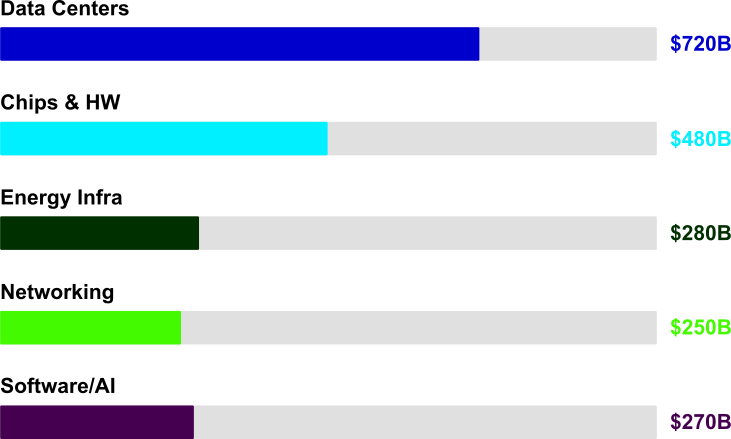
Annual global spending across hardware, data centers, and energy infrastructure (USD billions)
// IRS § 41
R&D Tax Credit
Businesses that are improving or building new products or processes can claim a dollar-for-dollar credit against federal tax liability. Covers wages, contractor costs, and supply expenses for qualifying R&D activities — directly subsidizing the innovation layer of the AI stack. This includes fabricators, manufacturers, designers, and engineers.
20%
Credit on qualified research expenses above base
Manufacturing, Engineering, Software Dev
// IRS § 179D
Data, Analytics &
Reporting
Data centers are among the most energy-intensive buildings ever constructed. The 179D deduction rewards developers who design facilities meeting elevated energy efficiency standards. With cooling representing 30–40% of AI data center energy, 179D creates a direct financial incentive to engineer smarter, greener facilities from the ground up.
$5.65
Per sq ft deduction (max, prevailing wage met)
HVAC Systems,
Lighting,
Building Envelope
// IRS § 48 / IRA
AI-Enabled
Operations
The Inflation Reduction Act dramatically expanded the ITC for solar, wind, battery storage, and other clean energy assets. The ITC is a critical tool for subsidizing and financing the renewable energy projects that will power the AI infrastructure buildout for decades. Both public and private institutions are eligible.
6–70%
Credit on qualifying clean energy investment
Solar, Wind,
Battery Storage,
Fuel Cell
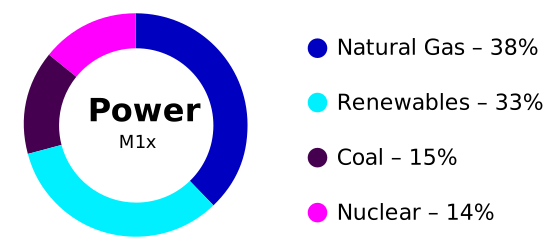
Energy Mix Snapshot
AI Data Center Power Sources (2024)
The AI sector’s power demand is reshaping energy markets. Hyperscalers are increasingly sourcing power directly from new generation, bypassing grid constraints. Nuclear PPA deals (Microsoft, Google, Amazon) signal a turn toward 24/7 carbon-free energy.
Capital Concentration
Where the $2T Is Going
Investment is concentrated at the compute and infrastructure layers, reflecting the “picks and shovels” thesis. The software layer will capture the most revenue long-term, but the physical buildout is the near-term capital sink.