AI Ownership Is Becoming the Next Competitive Frontier
Everyone has access to AI, but very few control it. As that distinction starts to matter, is ownership becoming the real competitive frontier?
The gap between access and ownership is quietly becoming the most important strategic question in financial services.
AI is already shaping credit decisions, incentive calculations, and compliance workflows. It’s no longer at the edges. It’s inside the core operating model. And that changes everything about how you should be thinking about it.
A Shift Is Underway
Until recently, owning your AI stack was impractical for most organizations, requiring too much infrastructure, too many specialist skills, and too long to implement. Most of the leaders I speak with accept this as simply the cost of doing business with AI.
That assumption no longer holds.
Last week I read about Mistral AI releasing Voxtral, a production-grade, open-weight model capable of running on minimal infrastructure without relying on external APIs. To me, it signaled something bigger than a product launch. For the first time, organizations can realistically run advanced AI within their own environments, keep sensitive data inside their governance boundaries, and eliminate dependence on external providers for critical workloads.
The “own versus rent” question has moved from a future discussion to an immediate design choice. Most organizations haven’t caught up to that yet.
“For the first time, organizations can realistically run advanced AI within their own environments, keep sensitive data inside their governance boundaries, and eliminate dependence on external providers for critical workloads.”
The Risk of Before. The Opportunity of Now.
The first wave of enterprise AI was defined by speed – and rightly so. Cloud-based services removed friction and got AI into production fast. Organizations moved from proof of concept to live deployment in weeks. That was genuinely valuable.
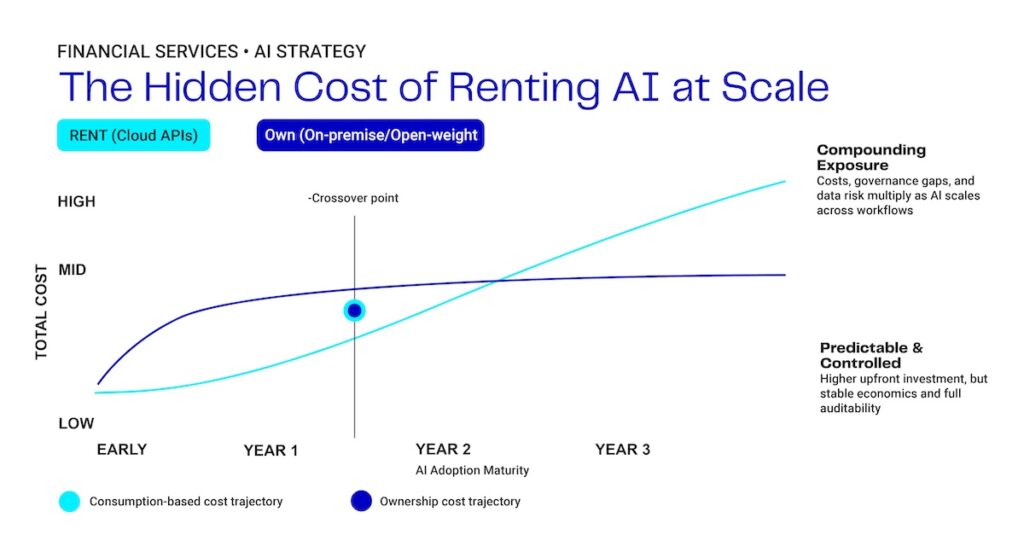
But it introduced a structural dependency that is easy to overlook until it isn’t. Data processed outside your control. Model behavior evolving without your governance. Costs increase with usage, not strategy.
At a small scale, that trade-off works. At enterprise scale, especially in decision-critical environments, it becomes a liability.
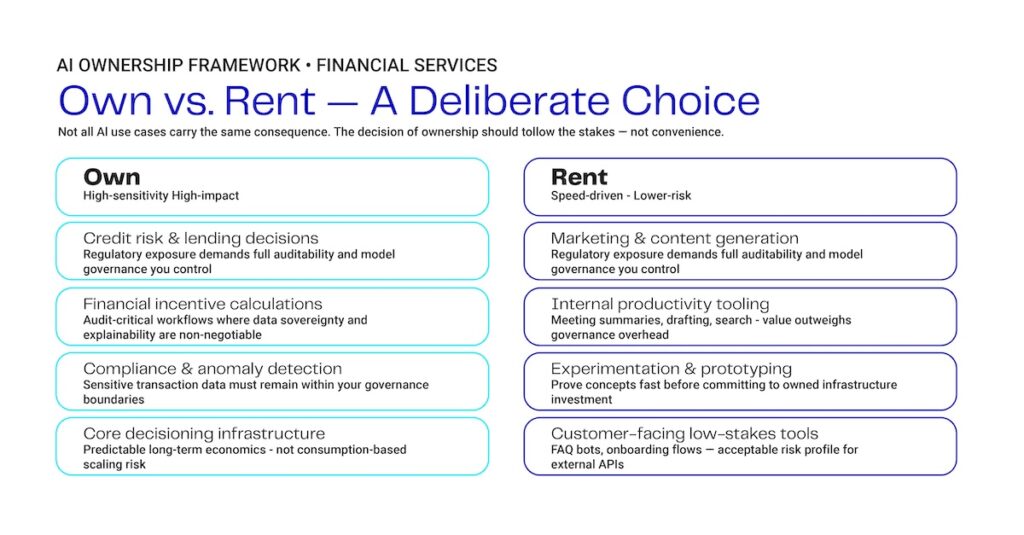
In financial services, the stakes are particularly high. There is a fundamental difference between AI generating marketing copy and AI influencing a credit approval, calculating financial incentives, or flagging anomalies in transactions. When I talk to risk and compliance leaders, three requirements come up consistently, and I’d encourage any organization to map their AI use cases against them.
These are not technical preferences. They are business requirements. And in my experience, they cannot be fully met without ownership.
The Economics Are Shifting Too
Here is something I think gets underestimated in most of these conversations: cost.
External AI services operate on a consumption-based pricing model. This means an organization is paying per token, per request, per interaction. That works early. But as AI embeds deeper across workflows, costs compound, often in ways that catch finance teams off guard.
Ownership requires a higher upfront investment. But it delivers something consumption models cannot: predictability. And as AI moves from experimentation into core operations, the question I’m hearing more often is no longer can we afford to own it, it’s can we afford not to?


This Is Not a Binary Decision
I want to be clear about something: this is not an argument for ripping out everything and building from scratch.
The most effective organizations I see are not choosing between owning and renting. They are designing deliberately.
Ownership is not about replacing everything. It is about being intentional about what matters most and having the conviction to act on that.

The Question Worth Sitting With
AI is influencing more decisions across your organization every day. The competitive gap is no longer defined by who uses AI; it is defined by who controls how it is used.
So I’ll leave you with a simple question:
Which of those decisions are too important to outsource?
How you answer that will shape your architecture, your risk posture, and ultimately your competitive position.
Arun Sahu is Head of AI, Data and Applied Intelligence at alliant, where he leads advanced technology evangelization with a business-first approach. He brings extensive experience as a former Global Chief Technology Officer within a large global IT services organization. In his previous roles, Arun founded and scaled enterprise Data and AI practices, delivering solutions across agentic systems, digital humans, geospatial and industrial AI, public sector platforms, and synthetic data.